INTERNATIONAL ISLAMIC UNIVERSITY MALAYSIA
Title: Egyptian Pyramids
Prepared By: Abduselam Mahmutovic
For my own personal interest
About Ancient Egypt and Pyramids
Acknowledgment
I want to mention that, I have enjoyed writing this assignment and I have got support from many people. All collation of data which I collected was my personal interest. Personally I searched help from the IIUM, Library assistant. This assistant has helped me to get to find information’s on my project. For more information’s about my project I have personally asked Prof. Dr. Ghassan Taha Yaseen for the books which helped me in my project the most, about the Great Step Pyramid, the Step Pyramid and other necessary information’s. From the third side, I have got many web sites where I found very useful general information about building Egyptian Pyramid etc. It’s been a pleasure. This time I want to thank to everybody who has helped me and who has contributed in this work.
Contents
-Dedication
-Acknowledgment
-Definition
-The Historical Background of Pyramids
-Archaic period; 1st and 2nd Dynasties
-The Old Kingdom; 3rd to 6th Dynasties
-The Middle Kingdom; 11th and 12th Dynasties
-The Neo Kingdom
---The Great Pyramid
---The Step Pyramid
-Religion during Ancient Egypt time
-The function of Pyramid
-The Pyramid Complex
-Conclusion
-Bibliography
Definition
Egypt is located in African continent. It is in North-Eastern Africa, bordered by Mediterranean Sea to the north of Egypt and there is Israel and the Red Sea to the East, Sudan to the South and Libya to the west. There is one of the biggest and most famous rivers in the world which is called Nile; it goes through all Egypt country and through all Africa. The capital city of Egypt is Cairo or Greater Cairo. As we know from history sources that Egypt is the most famous with their Pyramids. We can find also many other Pyramids in many countries such as Sudan United States etc. But Egyptians are the most famous and the first built in history as well as the oldest in the World. There are many Pyramids in Egypt. Approximately there are more then eighty other Pyramids in Egypt. It is very important for everybody to know that each Pyramid is built by a royal families Pharaoh or king. They have biggest and the oldest construction and the oldest stones are the Egyptian Pyramids. Ancient Egyptians built Pyramid in very large structure; it has four triangular sides which meet at the top directly. As well there are different Pyramids. All Pyramids are built about 2630 BC until 1530 BC.
Historical Background of Pyramids
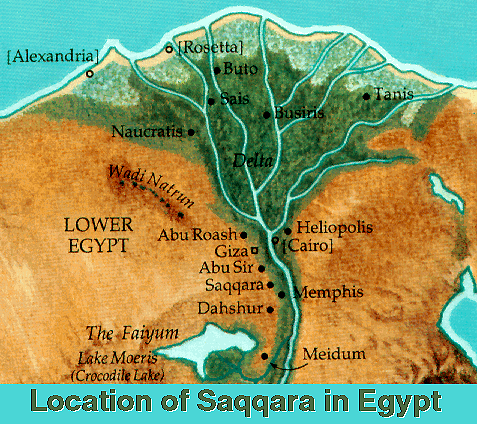
The form of Pyramid developed from royal tombs very early in Egyptian History. It happened in 1st and 2nd dynasty 2920 BC-2770 BC and 2770 BC-2649 BC. Kings were buried in the city of Abydos in graves. Later on in 3rd dynasty kings were buried in the place which is called `mastaba` in Arabic word which means `bench`. King Djoser had built in his Pyramid in saqqarah. That Pyramid was called The Great Step Pyramid. He built many `mastaba` inside and he was buried in his Pyramid. From time to time that `mastaba` was becoming smaller and smaller, that later on no one could realize what it is.
King Sneferu, the father of Khufu, he has built the initial true Pyramids, developing the new technique during construction. The earliest true pyramid, in the city of Maydum, began as a step Pyramid with inward leaning walls and eight levels. After working on the structure for 14 years, Sneferu moved his burial ground North to Dashur for unknown reasons, and construction began on another Pyramid. This one was made of stone blocks that leaned inward. The architects had designed it with an angle of 60 degrees to the ground, but as the Pyramid rose, it started to sink because, of the weight and angle of the stones. To solve this problem, the builders put up an outer supporting wall, giving the half finished Pyramid a shallower angle of 55 degrees. After this, the architects finished the top portion of the Pyramid with a slope of only 43 degrees. This shift in angle from 55-43 degrees gives this Pyramid which is called The Bent Pyramid.
During construction of the Bent Pyramid, the architects made a discovery. That on the upper portion, instead of leaning the stones inward, they laid down horizontal layers of larger stone blocks. With the new technique, the pyramid shape resulted because; each level was slightly smaller than the one it lay upon. The new technique was then used to construct another giant Pyramid for Sneferu, which is called today the North Pyramid, which is located about 1.6 km 1 mi north of the Bent Pyramid. It proved very successful that Sneferu returned to Maydum, during construction was still in progress on the two Dashur Pyramids, and refined the Maydum Pyramid by adding an outer level constructed with the new approach. All the Pyramid builders of the 4th dynasty 2575 BC - 2467 BC, including the builders of the Great Pyramid at Giza, used Sneferu’s new technique. Over the course of the 5th Dynasty 2465 BC-2323 BC however, the quality of the royal Pyramids declined. These Pyramids of the Middle Kingdom resemble those of the late Old Kingdom, being loosely constructed of rough stones, debris, and mud brick, and coated with fine limestone. The reign of Senworset 2 1897 BC - 1878 BC, builders altered this simple and predictable arrangement. During the rest of the Middle Kingdom, royal Pyramids became complicated in plan, presumably to foil the intentions of tomb robbers. In the New Kingdom 1550 BC-1070 BC, kings were no longer buried in Pyramids. They moved them to the site of royal tombs to the Valley of the Kings near Luxor.
Archaic period 1st and 2nd Dynasties
The early archaic period in 1st and 2nd Dynasty was much trouble as we think. That is when Egyptian History started at this period of time exactly. It immediately started at this time unification of Upper and Lover Egypt. That means Egypt was divided into two parts. It happened about c. 3150 BC. That is generally to include 1st and 2nd Dynasty. Not many sources are available of this period of time but some sources, are represented from pictographs. Some sources say that Upper Egypt was conquering Lover Egypt. It is important to know that Upper Egypt is south and Lover Egypt is North side. That is because the Nile River starts from Uganda’s lake called Victoria and goes to Sudan and Egypt then enter into Mediterranean Sea. The king named Menes is the first king of united Egypt. However, he was the holder of crown of Lover Egypt. Even at the time there were other kings such as; Narmer and Scorpion. They wanted to show with this kingship unification of the country. It is very important that all these kings named as “Horus”. While queens named as “Neith”. Very famous Plato was writing about Egypt, and he knew what was happening in Egypt. Ass well the result show us that Island Crete in Greece and Egypt had some relationship. In 2nd Dynasty something serious happened and that is, the line of tombs at Saqqara ends. There seems to be some kind of compromise to the authority or the power of the kings. Very soon another situation emerged that the King Sekhemib abandon his name and along with it the title Horus, then he becomes Seth king and with new name Peribsen. The 1st and 2nd Dynasty ended with beginning of the Old Kingdom.
The Old Kingdom 3rd to 6th
Dynasty
The 3rd Dynasty becomes the most relatively moment in the human History. That is because; most Pyramids were built at this period of time. For example King Djoser built his Step Pyramid. The Kings had represented themselves by building Pyramids ant Tombs and etc. It is very miracle thing and construction what they have built at the time. The 4th Dynasty is not just strange how Khufu Pyramid was built on such a scale, but how his father Sneferu built three of them nearly as big as Khufu. It is difficult to imagine how much money Sneferu had and to build Pyramid for such a long time. Mostly Pyramids were built at the west side of river Nile. And also they would work on Pyramids mostly when river Nile becomes deepest and widest. It was done in 5th Dynasty at that they work with moving stones mostly. In the 6th Dynasty everything ends with King Pepi 2. This Pepi 2 King was writing very nice letters and during that time many tombs were lost and never found again. Today sources says some stories are not true about it some yes from Historical evidence.
The Middle Kingdom; 11th and 12th Dynasties
This period of time was classic period. In this time they didn’t build Pyramids or Tombs or anything related to it. What happened is the question. This period of time from some sources is famous o conquering most of Egypt. There were many battles between Egypt and Syria and Palestine. This period is not like the Dynasties earlier or after 12th Dynasty. It happened 11th and 12th Dynasty was cut cult of Osiris. The important situation that happened is that Egyptian language from this time until the rest of Egyptian History.
The Neo Kingdom
The New Kingdom is known with an intimacy that is missing mostly from much of the rest of Egyptian history. The fact that we have the mummies of most of the kings is extraordinary enough. Moderns cannot gaze upon the dead face of Alexander or Caesar, historians wondering whether people like Moses or Jesus even existed, but Thutmose III, Ramesses 2, and the others lie under glass in their room of the Cairo Museum, and most of their historical evidences are in Egypt Museum. The ritual decoration of their tombs, to be sure, tells us little either about their personal lives or about the history of their reigns, but we are favored with some vivid accounts on contemporary temple decoration and in private tombs. For some of the most exciting events of the period, like the reigns of Hatshepsut or Akhenaton, these are incomplete accounts with tantalizing uncertainties. For long, no positively identified mummies of this female king or of the Great Heretic, or knowledge of their fate, was in our possession. However, a mummy from KV 60 has been positively identified as Hatshepsut. This was affected with the use of a canopic box, marked with Hatshepsut's name, which originally had been found in one of the great caches of royal mummies. This contained the liver and intestines of the Queen, along with a tooth, a molar, from which one root had been broken off. As it happened, the detached root was still in the jaw of the mummy in KV 60. This now answers the question of Hatshepsut's fate. The KV 60 mummy had both a pelvic tumor and a serious dental abscess. Death occurred from toxic shock when Egyptian doctors pulled a tooth the broken molar to drain the abscess, and the infection got into Hatshepsut's bloodstream.
The Great Pyramid
The largest Pyramid ever built is Great Pyramid. Its built by King Khufu`s, its usually called Great Pyramid. Great Pyramid is located in the desert west of Giza. Near the great Pyramid there are two more Pyramids called Khafre and Mankaure, these two Pyramids are built by King Khufu`s son and his grandson. The Great Pyramid was built during Khufu`s reign 2551 BC-2528 BC. Vandals and Erosion have took away some of the great Pyramid’s material like the top of the Pyramid, but it steel retains its sense of majesty. The Great Pyramid is constructed its base perfectly. With only 19 cm about 7.5 in that is between its longest and shortest sides, and the total length which reaches about 230 m 756 ft. When they newly completed they reached 146.7 m which is 481.4 ft. nearly 50 stories high. Some researchers estimate that 2.3 million blocks were used to build The Great Pyramid. Each block was heavy about 2.5 tons.
For the work of the Great Pyramid were used 25.000 men. That is 2.000 men would carry this heavy stones. All these workers were qualified and they were skilled for architect. Some people might think that they were slaves of the king but they were not slaves. They were employed by the king. They lived around construction of Pyramid. In building Khufu`s Pyramid the architect they used techniques developed by earlier Pyramid builders. They selected a site at Giza on a relatively flat area of bedrock not Sand it provided them a stable foundation. After carefully surveying the site and laying down the first level of stones, they constructed a Great Pyramid in horizontal levels like one of the top on the other. Most of the stones for interior of the Pyramid were directly carried to the south of the construction site. But exterior sides were had to be carefully cut that the stones would feet near to each other. During the middle ages from 5th to 15th century some exterior stones were like stolen for constructing the Cairo city the rest remained. The workers had to be careful for height and width of those stones they had to be exactly equal so that all four sides will look same from outside. After The Great Pyramid was finished, as I mentioned just now that some stones were stolen and those stones were took away. The workers had polished the area were there was missing so that everything will look same, like it was not stolen. In the end Pyramid looked in its full majesty. Inside the Great Pyramid there are many different rooms. For example, the King had everything designed for him whatever he wanted and whatever he needed. The King of the Pyramid had rooms for his wealth such as gold’s food etc. For his guests had room ass well for himself rooms because, many people were living life inside the Pyramid not only The Great Pyramid, but almost all other Pyramids. There was also Kings Chamber. Workers also had Chamber from where air comes inside. Well some researchers say that the Kings are buried inside the Pyramid, and that there are made on the walls pictures, picture of the King workers their woman etc. According to those pictures we are today able to see how exactly they were looking and nowadays many pictures are available.
The Step Pyramid
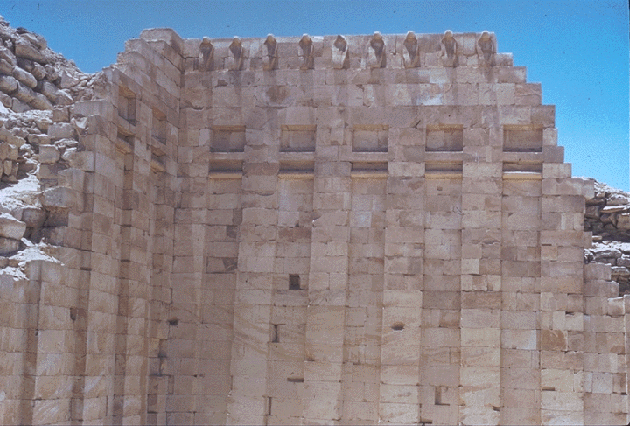
The first Pyramid which is built by Pharaoh Djoser at Saqqara around 2650 BC. In 3rd dynasty this type of Pyramid is built of six step levels, and they reached 200 ft which is 60 meters high. It is proven that this Pyramid is first and also the largest stone used more then everywhere in the world. The step Pyramid started from mastaba as I mentioned before. The Djoser wanted to build mastaba and they end up with first step Pyramid in the world. The mastaba they built in underground, it was a big box and there were big walls. Approximately more than 200.000 tons of stone was used to make the additional two tiers that went above the existing two tiered structure. In Djoser chamber was found his stone statue which is today in Cairo Museum, and all wealthy things are gone even many peace of stones.
From the northern part of Pyramid there is Mortuary Temple. The Southern Tomb is located just outside of the southern wall. Steps lead up the wall to the other tombs and monuments outside the walls. On the left side of the stairs, there is a large hole.
At the bottom of this hole, there is entrance that leads to an amazing set of chambers. This Southern Tomb is closed to the public. These chambers are also lined with the blue tiles that are found in the burial chambers in the Step Pyramid. The inscriptions which are found in these chambers are remarkable. They are perfectly executed and no very in line. Djoser wanted to prove that he is good king so he built the sport arena just beside Pyramid. He was announced for King of upper and lover part of Egypt. In that arena he would be in that arena and everybody from all over the Egypt would come to watch him. Those are the reasons why he was re crowned. He was King for many years in that part of the world. Those pharaohs who followed King Djoser, they also built step Pyramids temples etc.
Religion during Ancient Egypt Time
Today in the world most religions are Christianity, Judaism, Islam and Buddhism. There is one smaller number Hinduism. Ancient Egyptian religion was very important to them. The most things they believed in Kingship, they believed in Pharaoh. They believed that Pharaoh is not only political ruler or King etc. But also they are Gods. Each King was presented as God in his area. All Egyptians believed in that because they were very powerful kings. Egyptians also believed in Osiris, after Pharaoh Die he will become Osiris which means to help people afterlife. Egyptian religion they have never constituted a single orientation; it was always number of cults and orientations. The religion of Ancient Egypt was a polytheistic many gods religion with one short period of monotheism one god. Their religion had about 700 different which they call gods and goddesses. These cults and orientations shared a world view of fairly similar ideas. They focused on the stability of the universe and what exist, they believed somehow little in a continuous change. Ancient Religion was to extent Science, Law, Ethics and Philosophy. One of the more famous aspects of the Egyptian religious beliefs was their ideas of the afterlife.
They believed the physical body had to be preserved to allow a place for their spirit in their afterlife. Because of this, mummification was performed to preserve the body. In addition, large pyramids were constructed as tombs for the pharaohs in the Old Kingdom. Later, tombs were used to bury the pharaohs. Towards the end of its period, Ancient Egyptian religion started to interact with religious beliefs from other part of the world from Mediterranean Sea, and Egyptian religion saw several parallel and competing orientations, as strong changes of the orthodox creed over time. It is important to mention that all Ancient Egyptians Gods needed to be buried and high priest would wash their body and put perfume on body. Some of them make big festivals and they have attracted people from far away to visit Egyptians.
The function of Pyramid
The beautiful construction that was built as Pyramid in Egypt, the Kings or Pharaohs they made Pyramid for themselves only and for their purposes not other then that. For example, in Pyramid of Giza historians believe that there was chamber under the ground inside Giza, and that was just for the King who built it. After they pass away they would wanted to be buried inside in his Pyramid. That was some kind of religion and the rule of Ancient Egypt time. When body is buried they wanted it to be secret all of it. Many Historians and Egyptologist believe that Pyramid is served to be as Tombs for the Pharaohs. There are many reasons why they hold this to be true. One is that the pyramid structure represents just one point in the long continuum of the evolution of tomb design. Long before dynastic kings ruled Egypt, tombs were little more than open pit graves. In time, modifications were made. The pit was lined with crude brick and roofed with wood, and the number of chambers increased. The tomb was surmounted by a modest superstructure a mound of gravel with an outer layer of mud, most probably in imitation of the Primal Mound, the epitome of creation and regeneration.
By the 2nd Dynasty, brick corbel roofs had been introduced as building technique advanced. Such a roof took the appearance of a dome or vault. At this time the Mastaba superstructure so called because of its bench-like shape was common. These were rectangular in plan, with flat roofs and walls that slope outward to the ground. By the end of the 2nd Dynasty, royal tombs were subterranean chambers cut deeply into the stone, accessed by stairways, with Mastaba structures above them. The 3rd Dynasty saw the true pyramid-shaped superstructure take form, first as a stepped pyramid successive tiers of Mastabas built upon one another and descending in size to the top; see photo above and then as a true pyramid with smooth sides. The Pyramid Age reached its apex at the beginning of the 4th Dynasty with the construction of the pyramids at Dashur and Giza, but by the end of that dynasty, pyramids had become smaller until its last pharaoh, Shepseskaf, reverted to the Mastaba shape for his tomb. Though Pyramids would again be built in the 5th Dynasty, they would be of inferior quality and materials. Pyramid tombs remained popular through the 13th Dynasty, though none would rival those of the Pyramid Age in size or endurance. By the 18th Dynasty and onwards, following several Pyramid revivals, royal tombs had largely become underground tombs with no superstructure. Later on many things were stolen from Pyramids. They did not take care of them well. People used to steal all wealthy things even the stones from Pyramid. However many Historical evidences are lost in this way by stealing from inside the Pyramid and outside it.
The Pyramid Complex
The Great Pyramid was compiled from all of the standard elements of a Pyramid complex. Unfortunately most of them have degraded or disappeared after while. Originally, the Pyramid was surrounded by a Tura limestone wall from over eight feet high, which enclosed a paved limestone courtyard. Access to the courtyard was from the valley temple, mortuary temple and the causeway.
Flanking the Pyramid there were three small Pyramids intended for Egyptian queens, a small cult Pyramid, and a number of boat pits and other structures. The Pyramid itself was cased in Tura Limestone, which would have shone in the midday sun, and topped by gold Pyramid. Also the King Djoser had a complex Pyramid in his Step Pyramid. It was much different from the Great Pyramid. King Djoser had a tomb which is built of stone etc. Not all Pyramids had complex just the most famous Pyramids had complex beside it. Most Pyramids were just Pyramids while Great Pyramid had many things as I mentioned earlier.
Conclusion
In the end it is very strange today when we look at the History, and Pyramids. Many people keep asking themselves how the succeeded in building the biggest construction of all times at that time, that is just so beautiful and amazing. When we look at everything in Egypt it looks like everything representing something such as building Pyramids on west side of Nile River. For me personally I think that all Pharaohs that built a Pyramid, they wanted themselves to be remembered and to be written in the book of History. Beside that Pyramids represented many other thing religious views social life etc. It is very important that I have really enjoyed and getting knowledge about Ancient Egypt.
References
1. Putnam J. (2002) Eyewitness Pyramid, Great Britain, Dorling Kindersley Limited 80 Strand, London P. 10
3. Rosalie A. (1975) The Egyptian Kingdoms, Elsevier Phaidon, an imprint of Phaidon Press Ltd. P. 35
4. Saggs H. (1989) Civilization before Greece and Rome, United Kingdom B.T. Batsford, Ltd. United States Yale University Press PP. 267, 270
5. http://www.ancientegypt.co.uk/menu.html
6. http://www.iwebquest.com/egypt/ancientegypt.htm
7. http://en.wikipedia.org/wiki/Ancient_Egyptian_religion
8. http://i-cias.com/e.o/egypt_rl.htm
9. Weeks J. (1971-1993) the Pyramids, Cambridge University Press
10. L. Sprague de Camp (1974) The Ancient Engineers, double day company
Ballantine group
11. National Geographic (1995) the Nile Egypt
12. http://www.historylink101.net/egypt_1/religion.htm
13. http://www.catchpenny.org/index.html
14. http://www.friesian.com/notes/oldking.htm#archaic
15. http://en.wikipedia.org/wiki/Egypt
16. http://ccat.sas.upenn.edu/arth/zoser/08.gif
17. http://www.egyptologyonline.com/pyramids.htm
18. http://ccat.sas.upenn.edu/arth/zoser/10.gif
19. http://www.ancientegyptonline.co.uk/index.html